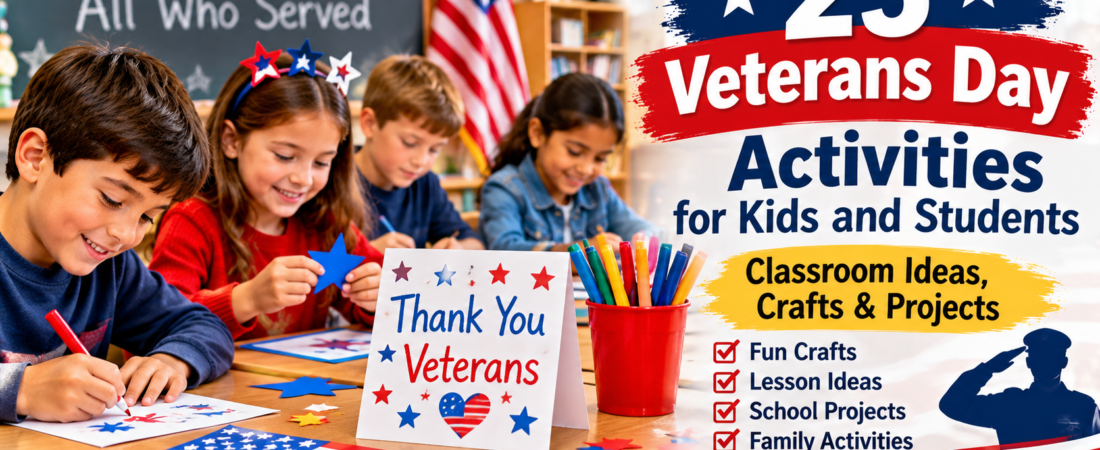
Veterans Day is an opportunity to teach children about military service, respect, gratitude and the people who have served in the United States Armed Forces. Observed every year on November 11, the holiday gives families, teachers and schools a chance to help young people understand why veterans are recognized and appreciated.
If you’re looking for Veterans Day activities for kids, classroom projects, easy patriotic crafts, school assembly ideas or educational activities for students, there are many meaningful ways to mark the occasion.
Children can create thank-you cards, interview a veteran, make American flag crafts, research military history, write appreciation messages or participate in a school recognition program.
This guide includes 25 Veterans Day activities for preschoolers, elementary students, middle schoolers and high school students. Most can be adapted for classrooms, homeschool lessons, youth groups or family activities at home.
What Is Veterans Day? A Simple Explanation for Kids
Before starting an activity, explain what Veterans Day means and why it is observed.
Veterans Day is a U.S. holiday that honors people who have served in the United States Armed Forces. It recognizes veterans who served during wartime and peacetime.
It is celebrated on November 11 each year because the armistice that ended fighting in World War I took effect on November 11, 1918.
Children should also understand the difference between Veterans Day and Memorial Day:
- Veterans Day: Honors everyone who has served in the U.S. military.
- Memorial Day: Remembers military personnel who died while serving their country.
For a more detailed explanation, read our guide to What Is Veterans Day? Meaning, Date, History and Facts.
25 Veterans Day Activities for Kids and Students
The following activities are organized by age group and learning style. Teachers can select a few activities for a single classroom lesson or combine several into a larger Veterans Day school program.
Veterans Day Activities for Preschool and Kindergarten
Younger children learn best through simple crafts, pictures, stories and hands-on activities. Keep instructions short and explain the meaning behind each project in age-appropriate language.
1. Make a Veterans Day Thank-You Card
Ask children to create handmade thank-you cards for veterans.
Provide construction paper, crayons, stickers, markers and patriotic decorations. Children can draw American flags, stars, flowers or simple pictures and write a short message.
Suggested messages include:
- Thank you for serving our country.
- We appreciate your service.
- Thank you for helping our community.
- We are grateful for you.
Teachers can arrange to deliver the cards through a local veterans organization, school contact or participating veteran. Always confirm the recipient and delivery arrangements before collecting personal information or promising delivery.
2. Create an American Flag Craft
An American flag craft is an easy way to introduce children to the national flag and its colors.
Materials needed:
- Red, white and blue construction paper
- Glue sticks
- Child-safe scissors
- Cotton swabs or crayons
- A flag reference picture
Ask children to create a paper flag using red and white stripes and a blue section with white stars.
Explain that the flag is a national symbol and that displaying it respectfully is part of many Veterans Day observances.
3. Veterans Day Coloring Pages
Give children age-appropriate Veterans Day coloring sheets featuring flags, stars, patriotic designs or simple thank-you messages.
You can use the finished pages to decorate classroom walls or create a Veterans Day display.
Teachers can also ask children to describe their pictures in one or two sentences.
4. Read a Veterans Day Story
Choose a children’s book about Veterans Day, military families, service or gratitude.
After reading, ask simple questions:
- Who is a veteran?
- Why do we thank veterans?
- What does it mean to serve?
- How can we show appreciation?
Avoid presenting war experiences in frightening detail to young children. Focus on service, community, kindness and respect.
5. Make a Paper Poppy or Star Decoration
Children can make paper stars or poppy-inspired decorations using colored paper, glue and safe craft supplies.
Explain that different communities use different symbols to remember military service and sacrifice. In the United States, red poppies are especially associated with remembrance traditions.
Display the finished decorations on a classroom bulletin board with a heading such as “Thank You to Our Veterans.”
Veterans Day Classroom Activities for Elementary Students
Elementary students can take part in more detailed projects that combine reading, writing, art and history.
6. Write a Letter to a Veteran
Ask students to write a short letter expressing appreciation to someone who has served in the military.
Give them a simple writing structure:
- Start with a greeting.
- Introduce yourself.
- Explain why you are writing.
- Share a respectful thank-you message.
- End with your name or first name, depending on the delivery arrangement.
Example:
“Dear Veteran,
Thank you for serving our country. I appreciate your dedication and the time you spent helping others. I hope you have a wonderful Veterans Day.
Sincerely,
A Student”
This activity helps children practice writing while learning how to express gratitude.
7. Create a Veterans Day Classroom Bulletin Board
Turn a classroom wall into a Veterans Day appreciation display.
Students can contribute:
- Handmade American flags
- Thank-you notes
- Paper stars
- Short appreciation messages
- Drawings
- Veterans Day facts
Use a simple title such as “Honoring All Who Served” or “Our Classroom Thanks America’s Veterans.”
8. Make a Veterans Day Word Search
Prepare a word search using Veterans Day vocabulary.
Suggested words:
- Veteran
- Service
- Honor
- Freedom
- America
- Military
- Courage
- Flag
- Respect
- November
After completing the puzzle, ask students to choose three words and explain what they mean.
This combines vocabulary practice with a short holiday lesson.
9. Create a Veterans Day Acrostic Poem
Ask students to write an acrostic poem using the word VETERANS.
Each line should begin with a letter from the word. Encourage students to use words related to service, respect, courage, gratitude and community.
For younger children, provide a list of suggested words. Older elementary students can create their own lines.
10. Build a Veterans Day Timeline
Help students understand the history of Veterans Day by creating a simple timeline.
Include important milestones:
- 1918: The World War I armistice took effect on November 11.
- 1919: President Woodrow Wilson recognized the first Armistice Day.
- 1938: November 11 became a federal legal holiday.
- 1954: The holiday was renamed Veterans Day to honor American veterans of all wars.
Students can illustrate each milestone with a small drawing or historical image.
Use the official U.S. Department of Veterans Affairs Veterans Day history and education resources to help verify historical information.
11. Make a Veterans Day Thank-You Poster
Divide students into small groups and ask each group to design a poster recognizing veterans.
Possible poster messages:
- Thank You for Your Service
- Honoring All Who Served
- We Appreciate Our Veterans
- Service Deserves Respect
Display the posters around the school or use them as decorations for a Veterans Day assembly.
12. Create a Veterans Day Fact Book
Students can create a small booklet containing facts about Veterans Day.
Suggested pages:
- What is Veterans Day?
- When is Veterans Day observed?
- Who does Veterans Day honor?
- Why is November 11 important?
- How do communities recognize veterans?
- How can children show appreciation?
Each page can include one fact and an illustration.
This project is useful for reading comprehension, basic research and writing practice.
Veterans Day Activities for Middle School Students
Middle school students can explore the subject in greater depth through research, interviews, group discussions and creative projects.
13. Interview a Veteran
Invite students to interview a veteran who is willing to share their experiences.
Possible questions include:
- What inspired you to serve?
- What was your military role?
- What did you learn during your service?
- What does Veterans Day mean to you?
- What would you like young people to understand about veterans?
Students can prepare a short written report or classroom presentation based on the interview.
Participation should always be voluntary. Ask permission before recording, photographing or sharing someone’s personal experiences. Avoid questions about traumatic or private experiences unless the veteran chooses to discuss them.
14. Research Different Branches of the U.S. Armed Forces
Divide the class into research groups. Assign each group one branch of the U.S. Armed Forces:
- Army
- Navy
- Marine Corps
- Air Force
- Space Force
- Coast Guard
Students can research each branch’s role, history, responsibilities and major milestones.
Each group can prepare a poster or short presentation.
15. Create a Veterans Day Presentation
Ask students to create a short presentation explaining the meaning and history of Veterans Day.
A presentation could include:
- Why Veterans Day is observed on November 11.
- How Armistice Day became Veterans Day.
- The difference between Veterans Day and Memorial Day.
- Ways communities recognize veterans.
- Why learning about military history matters.
Encourage students to use reliable government and educational sources rather than copying information from random websites.
16. Explore the Library of Congress Veterans History Project
The Library of Congress Veterans History Project collects and preserves the personal accounts of American veterans.
Students can explore interviews, photographs, letters and other historical materials to learn about military service through individual experiences.
A classroom assignment could ask students to:
- Select an available veteran interview.
- Identify the veteran’s service period.
- Summarize one important part of the account.
- Explain what they learned.
- Discuss why preserving personal histories matters.
Visit the Library of Congress Veterans History Project.
17. Organize a Veterans Day Debate or Discussion
Hold a guided classroom discussion around questions such as:
- Why is it important to recognize veterans?
- How can communities support veterans?
- Why should students learn about military history?
- What is the difference between remembering service and celebrating a holiday?
Set respectful discussion rules. The aim is to encourage historical understanding, listening and critical thinking rather than asking students to debate an individual veteran’s experiences.
Veterans Day Activities for High School Students
High school students can complete more advanced projects involving research, public speaking, history, community engagement and digital media.
18. Record a Veteran’s Oral History
Students can work with a willing veteran to document their personal history.
The project may include:
- A recorded interview
- A written biography
- Photographs or documents shared with permission
- A timeline of military service
- A reflection on the interview
This can become a school history project or a digital presentation.
Students should obtain clear permission before recording or publishing any interview. They should also respect requests to keep certain details private.
19. Create a Veterans Day Documentary
Students can produce a short documentary about Veterans Day, local veterans or the history of military service.
Possible documentary sections include:
- The origins of Veterans Day.
- The meaning of military service.
- Local veterans’ stories.
- Community celebrations.
- Ways to recognize veterans throughout the year.
Students can use original interviews, school-approved photographs, historical sources and narration.
20. Research a Local Veterans Memorial
Ask students to research a local veterans memorial, monument or cemetery.
They can investigate:
- When the memorial was built.
- Who it honors.
- Why the location was selected.
- What names or historical events are represented.
- How the community maintains the memorial.
Students can prepare a written report or presentation explaining what they discovered.
21. Organize a Veterans Appreciation Project
Students can plan a school or community project to recognize veterans.
Ideas include:
- Collecting appreciation cards.
- Organizing a school recognition event.
- Partnering with a local veterans organization.
- Helping with an approved community service activity.
- Creating an educational display about veterans.
Choose a project that meets the needs of the participating organization. Do not assume that veterans need a particular service or gift; ask the organization what would be useful.
22. Research Veterans in American History
Assign students to research a veteran who played an important role in American history.
They could study military service, public leadership, historical events or contributions to their community.
Students should use primary documents, official biographies and credible historical resources.
The National Archives education resources offer historical documents and learning materials that can support this type of project.
Veterans Day Activities for Families at Home
Parents who want to help children understand Veterans Day can also organize simple activities at home.
23. Write a Family Thank-You Message
Ask each family member to write one short message recognizing veterans.
Children can decorate the messages and combine them into a family appreciation poster or card.
If a family member is a veteran, let them decide whether they would like to share a story or simply receive a thank-you message.
24. Visit a Local Veterans Memorial
Find a veterans memorial, monument or military history site in your area.
Before visiting, explain what the location represents and why people gather there.
Encourage children to observe respectfully, read memorial inscriptions and ask age-appropriate questions.
Check the site’s visitor information before travelling.
25. Watch a Veterans Day Educational Program Together
Families can watch a suitable historical documentary, educational video or recorded Veterans Day ceremony.
Afterward, discuss:
- What did you learn about veterans?
- Why do Americans observe Veterans Day?
- What surprised you?
- How can we show appreciation to veterans?
Choose material appropriate for the child’s age and maturity.
Veterans Day Activities by Age Group: Quick Comparison
| Age group | Suitable activities |
|---|---|
| Preschool | Coloring pages, paper flags, simple thank-you cards |
| Kindergarten | Story reading, star crafts, classroom decorations |
| Elementary | Letters, word searches, posters, timelines, fact books |
| Middle school | Veteran interviews, research, presentations, discussions |
| High school | Oral histories, documentaries, memorial research, service projects |
| Families | Thank-you messages, memorial visits, educational programs |
Teachers can adjust the difficulty of each activity according to students’ reading, writing and research abilities.
Veterans Day School Assembly Ideas
A school assembly can bring students, teachers, veterans and families together for a respectful recognition program.
Here are some ideas for organizing a Veterans Day assembly.
1. Begin with a Welcome Message
A teacher or student representative can explain why the school is recognizing Veterans Day and welcome any invited guests.
2. Display the American Flag
The school can arrange a flag display or an appropriate flag ceremony. Make sure students understand basic flag etiquette and follow school and event guidelines.
3. Share a Short Veterans Day History Presentation
Students can explain the origins of Veterans Day, the importance of November 11 and the difference between Veterans Day and Memorial Day.
4. Invite a Veteran Guest Speaker
If a veteran is willing to participate, invite them to share a short personal account of their service or answer student questions.
Make participation voluntary and agree on the subject and length of the presentation in advance.
5. Display Student Artwork and Thank-You Cards
Showcase the cards, posters, poems and classroom projects created by students.
6. End with a Message of Appreciation
Close the assembly with a respectful thank-you message recognizing all who have served.
For additional ideas about public celebrations and ceremonies, read our guide to Veterans Day 2026 Events, Parades and Celebrations Across the USA.
Free Veterans Day Educational Resources for Teachers
Teachers and parents do not need to create every lesson from scratch. Several official and educational organizations provide resources for Veterans Day classroom activities.
1. 2026 Veterans Day Teachers Resource Guide – Department of Veterans Affairs
The U.S. Department of Veterans Affairs released its 2026 Veterans Day Teachers Resource Guide on November 2, 2026.
The guide is designed for teachers, youth leaders and community organizations. It includes:
- Classroom-ready lessons.
- Age-appropriate student activities.
- Writing prompts.
- Art projects.
- Veteran interview ideas.
- Service-learning opportunities.
- Scholarship information.
- Guidance for school and community events.
- Flag etiquette and patriotic observances.
This is one of the most useful current resources for educators planning Veterans Day lessons in 2026.
Official resource: 2026 Veterans Day Teachers Resource Guide – VA
2. National Education Association – Veterans Day in the Classroom
The National Education Association provides Veterans Day teaching ideas and educational resources for different grade levels.
Teachers can explore activities for elementary, middle and high school students, including lesson plans, background information and classroom resources.
Official resource: Veterans Day in the Classroom – NEA
3. Library of Congress – Veterans History Project
The Veterans History Project helps preserve the personal accounts of American veterans.
Students can use the collection to explore interviews, historical experiences and primary-source materials.
Official resource: Library of Congress Veterans History Project
4. National Archives – Educational Resources
The National Archives provides historical documents, photographs and educational tools that teachers can use to help students study American history.
These materials can support Veterans Day research assignments, document analysis and classroom presentations.
Official resource: National Archives Education Resources
5. HISTORY – Take a Veteran to School Day
The HISTORY initiative encourages schools to connect veterans with students so young people can hear personal stories of service and learn more about military history.
Its resources include planning guides, sample questions and materials for different grade levels.
Official resource: Take a Veteran to School Day – HISTORY
How to Explain Veterans Day to Young Children
Some children may not understand what military service means or why a national holiday recognizes veterans.
Parents and teachers can explain the subject using simple language.
For preschool and kindergarten children:
“Veterans are people who served in the military. Veterans Day is a special day when we thank them for helping and serving our country.”
For elementary students:
“Veterans Day honors people who have served in the United States military. Some served during wars, while others served during peaceful times. We recognize their dedication and thank them for their service.”
For middle and high school students:
“Veterans Day recognizes all who have served honorably in the U.S. Armed Forces. It is an opportunity to learn about military history, understand the experiences of veterans and recognize their contributions to American communities.”
Keep discussions respectful and age-appropriate. Not every veteran has the same experiences, and children should learn to appreciate individual stories without making assumptions.
How Can Students Show Appreciation to Veterans?
Students can show appreciation in several simple ways, including:
- Writing a personal thank-you letter.
- Participating in a school recognition program.
- Learning about veterans’ experiences.
- Creating an educational display.
- Supporting an approved community project.
- Listening respectfully to a veteran’s story.
- Helping organize a local recognition event.
The most important lesson is that appreciation should be sincere. Children do not need expensive gifts or complicated projects to recognize someone’s service.
Frequently Asked Questions About Veterans Day Activities for Kids
What are some easy Veterans Day activities for kids?
Easy activities include making thank-you cards, coloring patriotic pictures, creating paper American flags, writing appreciation messages and decorating classroom bulletin boards. These projects are suitable for younger children and require simple materials.
What are the best Veterans Day classroom activities for elementary students?
Elementary students can write letters to veterans, create posters, complete word searches, make acrostic poems, research Veterans Day facts and build a historical timeline. These activities combine creativity with reading, writing and history lessons.
What are some Veterans Day activities for preschoolers?
Preschoolers can color Veterans Day pictures, make paper stars, create simple flags, listen to age-appropriate stories and make thank-you cards with help from an adult.
What are some Veterans Day crafts for kids?
Popular Veterans Day crafts include American flag collages, paper stars, patriotic wreaths, thank-you cards, classroom posters and poppy-inspired paper decorations.
How do you teach kindergarten students about Veterans Day?
Use simple explanations, picture books, coloring activities and thank-you cards. Explain that veterans are people who served in the military and that Veterans Day is an opportunity to thank them.
What are some Veterans Day activities for middle school students?
Middle school students can interview veterans, research military branches, create presentations, explore the Library of Congress Veterans History Project and participate in guided classroom discussions.
What are some Veterans Day projects for high school students?
High school students can record oral histories, produce short documentaries, research local veterans memorials, study historical documents and organize community appreciation projects.
What can students write for Veterans Day?
Students can write thank-you letters, appreciation messages, short essays, poems, biographies and reflections about the importance of military service. A simple message such as “Thank you for serving our country” is also appropriate.
How can schools celebrate Veterans Day?
Schools can organize assemblies, invite veteran guest speakers, display student artwork, hold flag ceremonies, create appreciation cards and teach lessons about Veterans Day history.
Are there free Veterans Day lesson plans for teachers?
Yes. The Department of Veterans Affairs provides a 2026 Veterans Day Teachers Resource Guide with classroom lessons, activities and event-planning guidance. The National Education Association and National Archives also provide educational materials.
How can children thank a veteran?
Children can write a card, say thank you, participate in a school event or listen respectfully to a veteran’s story. If sending a card or gift, use an organization or recipient who has agreed to receive it.
What is the difference between Veterans Day and Memorial Day for students?
Veterans Day honors everyone who has served in the U.S. Armed Forces. Memorial Day specifically remembers military personnel who died while serving their country. Both holidays recognize military service, but their purposes are different.
Final Thoughts
Veterans Day provides a meaningful opportunity for children and students to learn about service, history, gratitude and community.
Whether children create thank-you cards, make American flag crafts, interview a veteran, research military history or participate in a school assembly, these activities can help them understand why November 11 matters.
Teachers can choose activities based on students’ ages and learning levels, while parents can use simple projects and conversations to introduce the meaning of the holiday at home.
Most importantly, help children understand that recognizing veterans is not limited to one day of the year. Respect, appreciation and a willingness to learn about their experiences can continue throughout the year.
For more holiday information, visit MemorialDayUSA and explore our other Veterans Day guides.