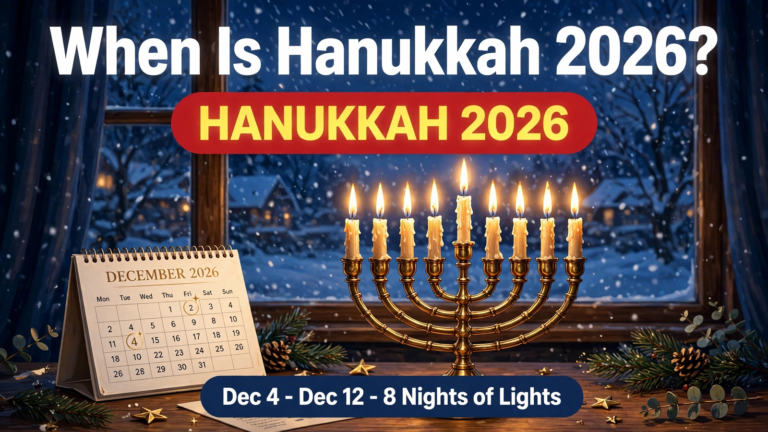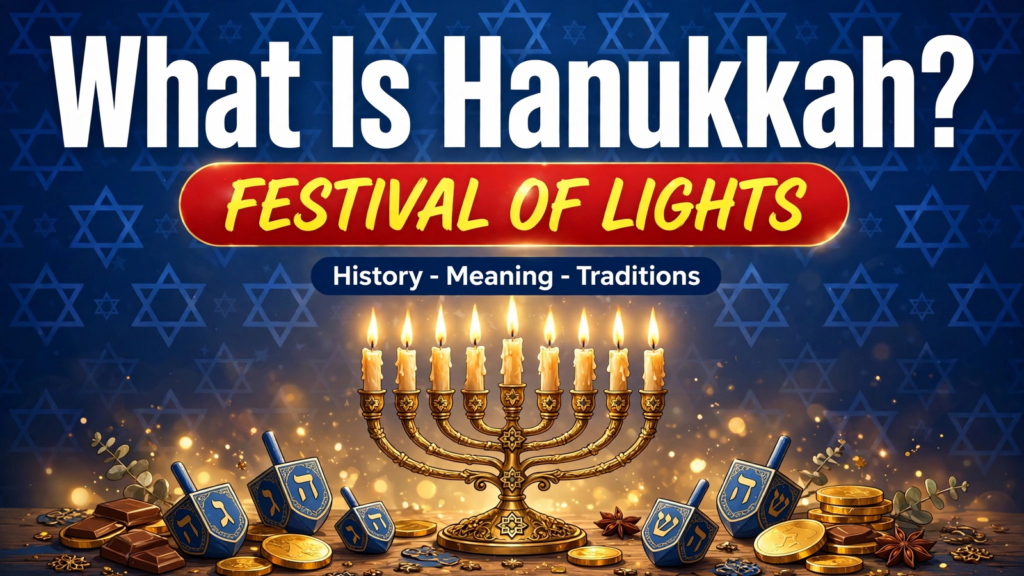
What is Hanukkah? Hanukkah is an eight-day Jewish holiday, also called the Festival of Lights, that celebrates the rededication of the Second Temple in Jerusalem after the Maccabees’ victory over the Seleucid Empire in the 2nd century BCE. Each night, families light one more candle on a nine-branched menorah, until all eight candles burn together on the final night. The name Hanukkah means “dedication” in Hebrew, and the holiday is marked with candle lighting, songs, the dreidel game, foods fried in oil, and gifts. In 2026, Hanukkah runs from sundown on Friday, December 4 to nightfall on Saturday, December 12.
What Does Hanukkah Mean?
The Hebrew word Hanukkah (also spelled Chanukah) means “dedication”. It refers to the rededication of the Second Temple in Jerusalem, which is the event the holiday remembers. Hanukkah is sometimes called the Festival of Lights, because of the nightly menorah lighting, and it is one of the best-known Jewish holidays in the world, even though it is a relatively minor holiday in Jewish religious law. It begins every year on 25 Kislev on the Hebrew calendar, which usually falls in late November or December, and it lasts for eight nights and eight days.
The History of Hanukkah: The Maccabees and the Temple
The story of Hanukkah goes back more than 2,000 years, to the 2nd century BCE. At the time, the land of Judea was ruled by the Seleucid Empire, a Greek-Syrian kingdom that had grown out of Alexander the Great’s empire. The Seleucid king Antiochus IV Epiphanes tried to force the Jews to abandon their religion: he banned Jewish practices and desecrated the Temple in Jerusalem, the holiest place in Judaism.
You may also like
A small band of Jewish rebels, led by the priest Mattathias and then by his son Judah Maccabee, rose up against the Seleucid army. Despite being heavily outnumbered, the Maccabees — the name means “the hammer” — defeated the Seleucids and recaptured Jerusalem. According to Britannica, the Temple was rededicated in 164 BCE, and the victory is recorded in the Books of the Maccabees, ancient Jewish texts preserved in the Catholic and Orthodox canons.
The Miracle of the Oil
When the Maccabees retook the Temple, they needed to relight the menorah, the sacred lamp that was meant to burn continually. According to the Talmud, they found only one small jar of pure olive oil that had not been defiled by the invaders — enough to keep the lamp burning for a single day. Miraculously, the oil lasted for eight days, until new consecrated oil could be prepared. That is why Hanukkah lasts eight nights, and why the holiday is celebrated by lighting candles — one more each night, until all eight burn together.
Historians note that the earliest sources describe the eight days as a delayed celebration of the autumn festival of Sukkot, which the Maccabees had been unable to observe during the fighting. Either way, the oil miracle is the story every Jewish child learns, and it is the reason oil-fried foods are part of the holiday.
The Traditions of Hanukkah
Hanukkah’s traditions are simple, joyful and mostly centred on the home. Here are the main ones, and where each comes from.
Lighting the menorah
The menorah used at Hanukkah, also called a hanukkiah, has nine branches: eight for the eight nights, plus a ninth candle called the shamash, the helper candle that lights the others. One candle is lit on the first night, two on the second, and so on. Candles are placed from right to left and lit from left to right, with the newest candle lit first. Two blessings are said before lighting each night, and a third, the Shehecheyanu, is added on the first night; Chabad.org’s Hanukkah guide gives the full text of the blessings. The lit menorah is traditionally placed in a window, so that passers-by can see it — publicising the miracle is part of the tradition.
The dreidel game
The dreidel is a four-sided spinning top, marked with the Hebrew letters nun, gimel, hei and shin. Together they stand for the phrase “Nes gadol hayah sham” — “a great miracle happened there”. (In Israel, the fourth letter is pei, for “po”, meaning “here”.) Children play the dreidel game with small stakes, usually chocolate coins or nuts.
Latkes and sufganiyot
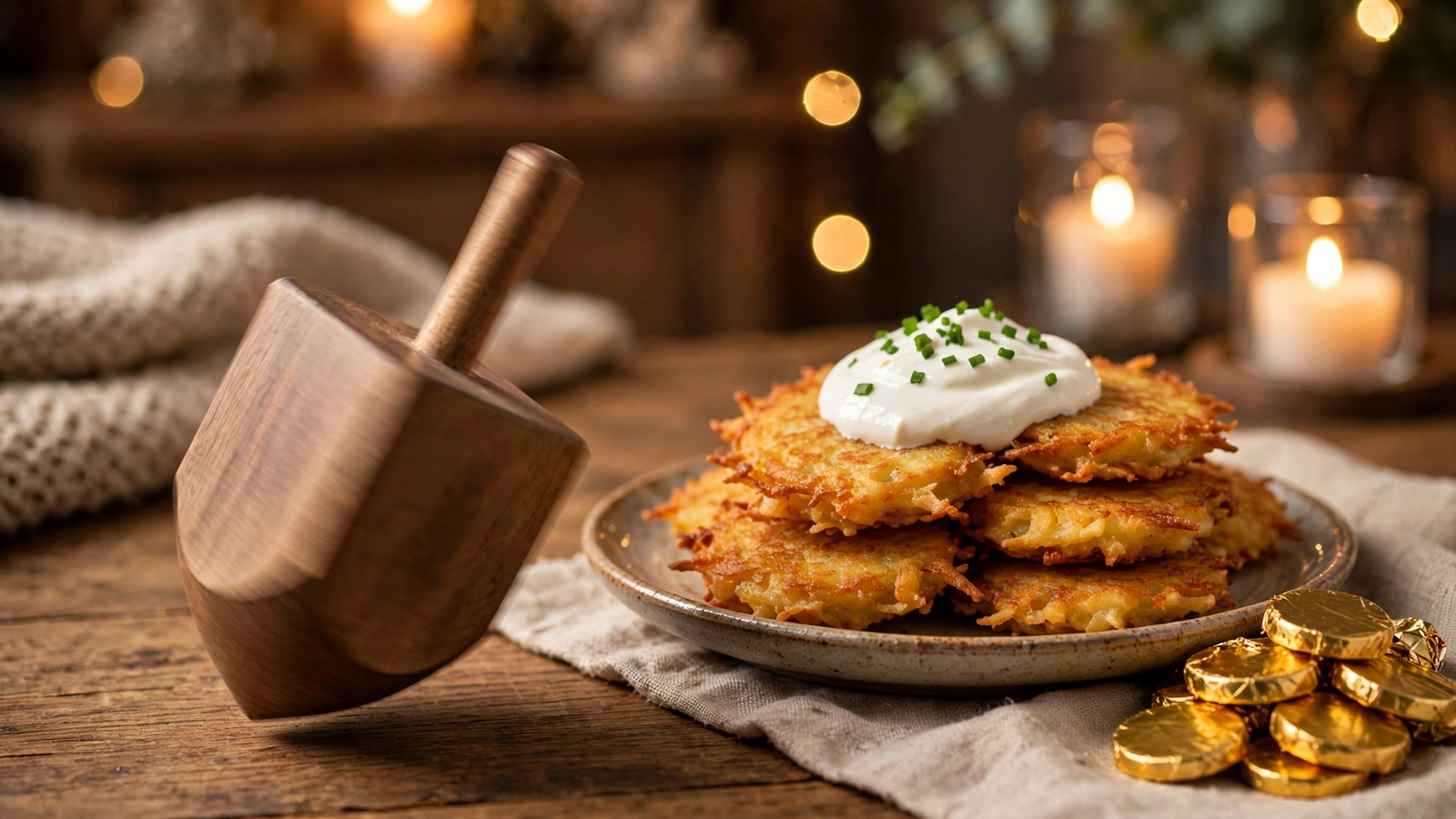
Foods fried in oil are eaten throughout Hanukkah to remember the miracle of the oil. Latkes are crisp potato pancakes, often served with sour cream or apple sauce, and they became a Hanukkah food in Eastern Europe, where potatoes were cheap and plentiful. Sufganiyot are round jelly doughnuts, dusted with sugar, and they are the classic Hanukkah treat in Israel. Dairy foods are also eaten, in memory of Judith, a Jewish heroine who, according to tradition, fed the enemy general salty cheese, then gave him wine and killed him.
Hanukkah gelt and gifts
Hanukkah gelt — “gelt” means money in Yiddish — is a small gift of money traditionally given to children, and today often takes the form of chocolate coins wrapped in gold foil. Gelt coins are also used as stakes in the dreidel game. Giving actual gifts is a newer custom: in the United States, where Hanukkah falls in the Christmas season, gift-giving grew from the 19th century onwards, and many families now exchange a small gift on each of the eight nights.
Songs and prayers
Each night after the candles are lit, families sing songs, including the traditional hymn Ma’oz Tzur (“Rock of Ages”), which retells the story of Jewish deliverance.
How Hanukkah Is Celebrated Today
For centuries Hanukkah was a modest home holiday. In America it grew into a major family celebration from the late 19th century onwards, as Jewish families built festive traditions around the eight nights: parties, decorations, special foods, and gifts for children. Today, families typically gather each evening to light the menorah together, eat latkes and sufganiyot, play dreidel, and exchange gifts. Many communities hold public menorah lightings in town squares, shopping centres and city halls.
Hanukkah is not a public holiday in the United States, the United Kingdom, Canada or Australia, so schools and offices stay open as normal. It is a public holiday in Israel, where the eight days are school holidays and the country is filled with festivals, doughnut stalls and public lightings.
Hanukkah vs Christmas: What Is the Difference?
Because Hanukkah usually falls in December, people often assume it is the Jewish Christmas. It is not. Christmas celebrates the birth of Jesus; Hanukkah celebrates a military victory and the rededication of a temple more than 2,000 years ago. Hanukkah is not one of the most important holidays in Jewish law — Yom Kippur, Passover and Rosh Hashanah are far more significant — but it has become one of the best-known, partly because it falls in the Christmas season. If you are planning around the other December holidays, our Christmas 2026 open and closed guide covers shops, banks and services for Christmas week.
When Is Hanukkah in 2026 and 2027?
Hanukkah 2026 runs from sundown on Friday, December 4 to nightfall on Saturday, December 12, 2026, according to Hebcal. Hanukkah 2027 falls much later: it begins at sundown on Friday, December 24, 2027 and ends at nightfall on Saturday, January 1, 2028 — running over Christmas itself. The date moves each year because Hanukkah is fixed to the Hebrew calendar, which follows the moon.
FAQs
What is Hanukkah?
Hanukkah is an eight-day Jewish holiday, the Festival of Lights, that celebrates the rededication of the Second Temple in Jerusalem after the Maccabees’ victory in the 2nd century BCE. It is marked by lighting one more candle on a menorah each night for eight nights.
Why is Hanukkah celebrated for eight days?
According to the Talmud, the small jar of pure olive oil found in the Temple should have lasted one day but miraculously burned for eight days. Hanukkah lasts eight nights to remember that miracle.
What does Hanukkah mean?
Hanukkah means “dedication” in Hebrew. It refers to the rededication of the Second Temple in Jerusalem after the Maccabees recaptured it from the Seleucid Empire.
When is Hanukkah 2026?
Hanukkah 2026 begins at sundown on Friday, December 4, 2026, and ends at nightfall on Saturday, December 12, 2026.
What is a menorah?
A menorah, also called a hanukkiah, is a nine-branched candelabrum used at Hanukkah. Eight branches hold the candles for the eight nights, and the ninth holds the shamash, the helper candle used to light the others.
What foods are eaten at Hanukkah?
Foods fried in oil, to remember the miracle of the oil: latkes (potato pancakes) and sufganiyot (jelly doughnuts). Dairy foods are also traditional, and children receive Hanukkah gelt, chocolate coins or small gifts of money.
Is Hanukkah the Jewish Christmas?
No. Hanukkah celebrates the rededication of the Temple in Jerusalem, while Christmas celebrates the birth of Jesus. They share a season of lights and gifts, but they are different festivals.
So, what is Hanukkah? It is the story of a small band of rebels who refused to give up their faith, a jar of oil that should have lasted one day and burned for eight, and eight nights of light in the darkest part of the year. Whether you light a menorah yourself or are simply curious about the holiday your neighbours celebrate, the heart of Hanukkah is the same: a little light, added one candle at a time, until the whole window glows. In 2026, the first candle is lit on the evening of Friday, December 4. More holiday guides are on the MemorialDayUSA homepage.